

A single vision lens is a mono visual lens that yields a single field of vision, whether there is no prescription or a single RX prescription.
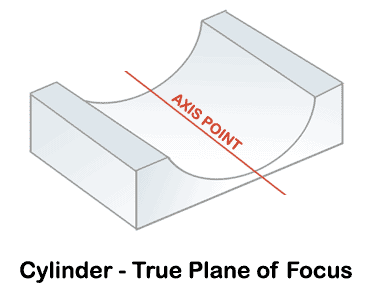
A single vision prescription lens may consist of two physical elements of correction. The two elements are a sphere and a cylinder, which are measured in diopters. The sphere is primarily used to help with visual acuity deficiency (nearsighted and farsighted patients). The cylinder is most commonly used to treat astigmatism. However, because of the anatomy of a cylinder, an axis is needed to identify the cylinders true plane of focus (see image below). on the other hand, the sphere identifies the element of correction, whether it is a minus(-) used to address nearsightedness or a plus (+) used to address farsightedness.
The sphere and cylinder are both not always needed simultaneously. There are many patients that require both a sphere and cylinder correction with their respective RX prescription, but it is not uncommon for a patient to require just one, a sphere correction to address acuity deficiency or a cylinder correction to just address astigmatism.
There are a couple different formats to interpret a cylinder reading. A minus (-) cylinder is most commonly written by Optometrist and has become an industry standard from dispensaries to labs. However, Ophthalmologists more often than not use a plus (+) cylinder reading when writing prescriptions. A prescription can generally look completely different, but yield the same visual results considering it is the same prescription, whether it is written as a plus (+) cylinder or minus (-) cylinder (see example below). There is actually a transposition formula (see formula below) to help interpret a prescription as a minus (-) or plus (+) cylinder prescription. Both yielding the same visual effect for a patient and technically both are the same prescription, but just prescribed as a plus or minus to accommodate the doctors preference.
First add the cylinder to the sphere = (+/- cylinder) + (+/- sphere)
Then change the sign of the cylinder to be opposite of its original sign (+/-)
Then change the axis 90 degrees. (if the axis is less than 90 degrees add 90 degrees to
axis, but if it is more than 90 degrees subtract 90 degrees)

A multifocal lens consist of more than one prescription within the lens. Early on, for the most part, the eye only needs a single prescription to accommodate all visual fields. As the eye matures the eye loses its elasticity leading to what is commonly referred to as presbyopia. This anatomical visual transition creates a need for a little more prescription to see objects at close range. The addition of prescription is referred to as the ADD power. The addition of this add power to a primary prescription (see single vision above) is the foundation for a multifocal lens. Multifocal lenses include progressives, trifocals, bifocals, quadrafocals, double segments and computer lenses. Below are links to view characteristics of each respective

